
From 1 January 2027, a PDF invoice is no longer enough
If your business turned over AED 50 million or more in its last accounting period, your invoices change on 1 January 2027. From that date, a PDF emailed to a customer is no longer a valid tax invoice for a B2B sale. Each invoice must leave your ERP as structured data, pass through an accredited service provider, reach your customer's provider and be reported to the Federal Tax Authority.
The deadline to appoint that provider was 30 October 2026. If you have signed with one, the hard part now sits inside your ERP: clean master data, the right fields on every invoice and a process that does not stall month-end. If you have not, you are already exposed to penalties.
This article sets out what the rules require, what changes inside Microsoft Dynamics 365 Business Central, and the steps to take in the weeks you have left.
How the UAE e-invoicing system works
The legal base is Ministerial Decisions No. 243 and No. 244 of 2025, issued by the Ministry of Finance on 29 September 2025, with amendments in 2026. The system covers B2B and B2G transactions. B2C sales are excluded until further notice.
The UAE uses a decentralised, Peppol-based "five-corner" model. Your ERP creates the invoice as structured data. Your accredited service provider (ASP) validates it against the UAE data standard, PINT AE, and sends it to your customer's ASP, which passes it to your customer's ERP. The ASPs report the tax data to the FTA in near real time.
Both the seller and the buyer need an ASP, and only providers accredited by the Ministry of Finance can do this work. A few transaction types are excluded, including certain sovereign government activity, international passenger air transport with e-tickets, and VAT-exempt or zero-rated financial services. International air freight with an airway bill has a temporary 24-month exclusion.
The timeline, and what the penalties look like
The rollout runs in three phases. The Phase 1 ASP deadline was moved from 31 July to 30 October 2026 by an amendment announced in May 2026; the go-live date did not move.
Pilot and voluntary adoption open
Phase 1 ASP appointment deadline
Phase 1 live: revenue AED 50m+
ASP deadline for everyone else and government
Below AED 50m live, then government entities
Penalties are set by Cabinet Decision No. 173 of 2026, which replaced Cabinet Decision No. 106 of 2025. As summarised by tax advisers:
- Not implementing the system or appointing an ASP: AED 5,000, then AED 5,000 for each further month, capped at AED 50,000 in any 12 months.
- Not issuing and transmitting an e-invoice or e-credit note: AED 100 each, capped at AED 5,000 a month.
- Not telling your ASP about changes to your registered data: AED 250 a day, capped at AED 5,000 a month.
Individually these are not large numbers. The real cost is operational: a customer whose system cannot accept your invoice may not pay it.
What actually changes inside your ERP
Most of the work is not the connection to the ASP. It is the data your ERP holds before an invoice is posted. An ASP will reject an invoice that does not meet the PINT AE data dictionary, and it cannot fix your master data for you.
✓Structured PINT AE data sent through your ASP
PDF by email
✓Validated on every B2B customer
Optional, often missing
✓Structured fields
Free text
✓Linked to the original invoice
Often unlinked
✓Imported as data and matched
Keyed in by hand
✓Sent, accepted or rejected, per document
No status after sending
Two more set-up areas need attention. VAT posting groups must map cleanly to the UAE tax categories, including zero-rated, exempt, out-of-scope and reverse charge. And structured invoices need standard units of measure, not "pcs" in one company and "nos" in another.
Seven steps to take before your go-live date
Check gross revenue for your most recent accounting period against the AED 50m threshold, for each legal entity.
Choose from the Ministry of Finance list. Ask how it connects to Business Central, how it reports rejections and what it charges per document.
Compare real posted invoices and credit notes against the PINT AE fields and list every missing or badly formatted field.
Validate TRNs, structure addresses, standardise units of measure and fix VAT posting groups, before testing starts.
Link every credit note to its invoice, name an owner for rejected documents and check the outbound queue daily.
Send every document type you use: standard, credit note, multi-currency, reverse charge, zero-rated. Confirm your largest customers can receive.
Watch rejections daily for the first month. If your systems fail, the FTA must be told within two business days.
0 of 7 Two or more unticked: you have gaps to close before go-live. A fitment analysis will list them.
Where Business Central and Xpert Clan fit
Business Central already has the foundations: structured customer, item and tax data, posting groups, and an E-Documents framework built to send and receive electronic documents through external services. What the UAE mandate adds is the local layer: PINT AE mapping, the ASP connection, validation before posting and a clear view of every document's status.
Xpert Clan's UAE e-invoicing extension supplies that layer inside Business Central, so your finance team works in the screens it already uses:
Sales invoices, credit notes and inbound purchase invoices.
TRNs, addresses and tax codes checked before a document is posted.
Documents sent to and received from your chosen provider.
Sent, accepted or rejected, on every document.
Fix and resend without leaving Business Central.
A record of every transmission for your auditors and the FTA.
The same approach runs across our industry extensions, so school fee invoices, property rent and service charges, and store sales all leave Business Central in the right format. Because it is an extension rather than a customisation, it stays upgrade-safe as Microsoft ships new releases.
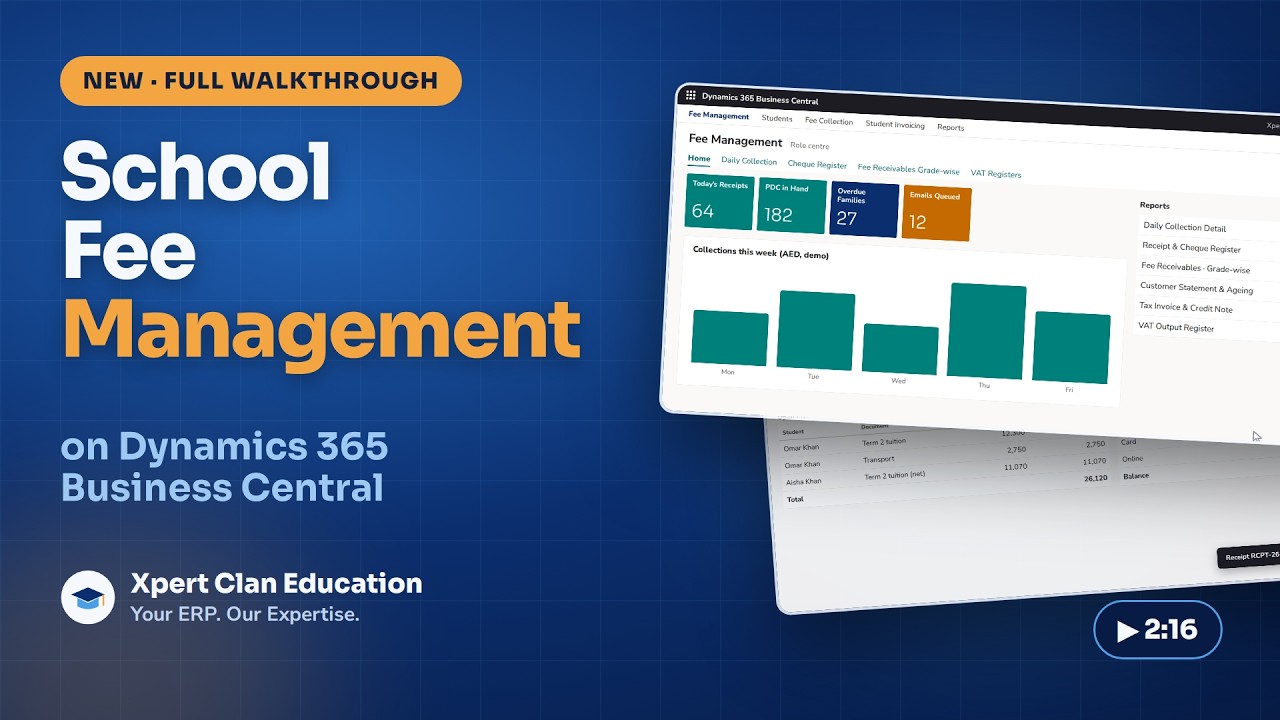 School feesFee invoices, e-invoice ready
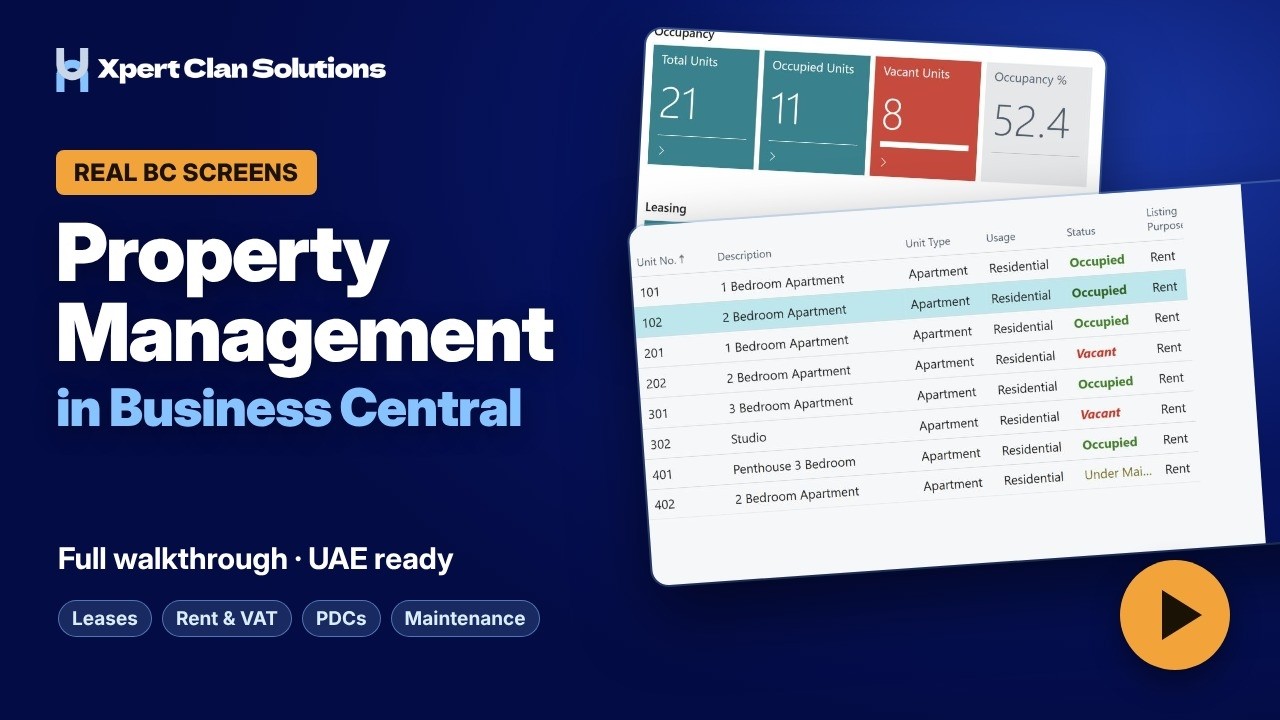 PropertyRent and service charges
 Online storeOrders into the ledger
Start with a fitment analysis
E-invoicing is a compliance deadline, but it is also the first time many UAE businesses will have every invoice validated before it leaves the building. Done well, it means cleaner receivables, fewer disputed invoices and supplier bills that arrive ready to match.
If you are on Business Central, or moving to it, we can review a sample of your invoices against PINT AE, list the gaps and give you a dated plan to go-live. If you are below AED 50m, you have until 1 July 2027: enough time to do this properly rather than in a rush.
Sources: KPMG, Andersen, BDO, Khaleej Times, Sovos, e-invoicing.org. This article is general guidance, not tax advice; check the latest Ministry of Finance decisions for your situation.
Get your e-invoicing gap list
Our e-invoicing fitment analysis checks your Business Central data and processes against PINT AE, so you know exactly what to fix before go-live.